


Adult open bites on North Donnelly Street
Your front teeth have never touched. You've spent years tearing food off with your side teeth, and now your dentist is talking about wear on the back ones, or about a crown.
Or the bite your braces closed in high school has crept open again.
Your open bite treatment in Mount Dora begins with a free half-hour visit with orthodontist Dr. Robert Ogden at 2110 N Donnelly St. Adults come in from Eustis, Tavares and the rest of the Golden Triangle, and being older doesn't rule treatment out.
Dr. Ogden has treated Lake County patients since 1994. Some parents who wore braces here after it opened in 2006 now bring in their own kids.
It costs nothing, you don't need a referral, and you won't be asked to decide that day.
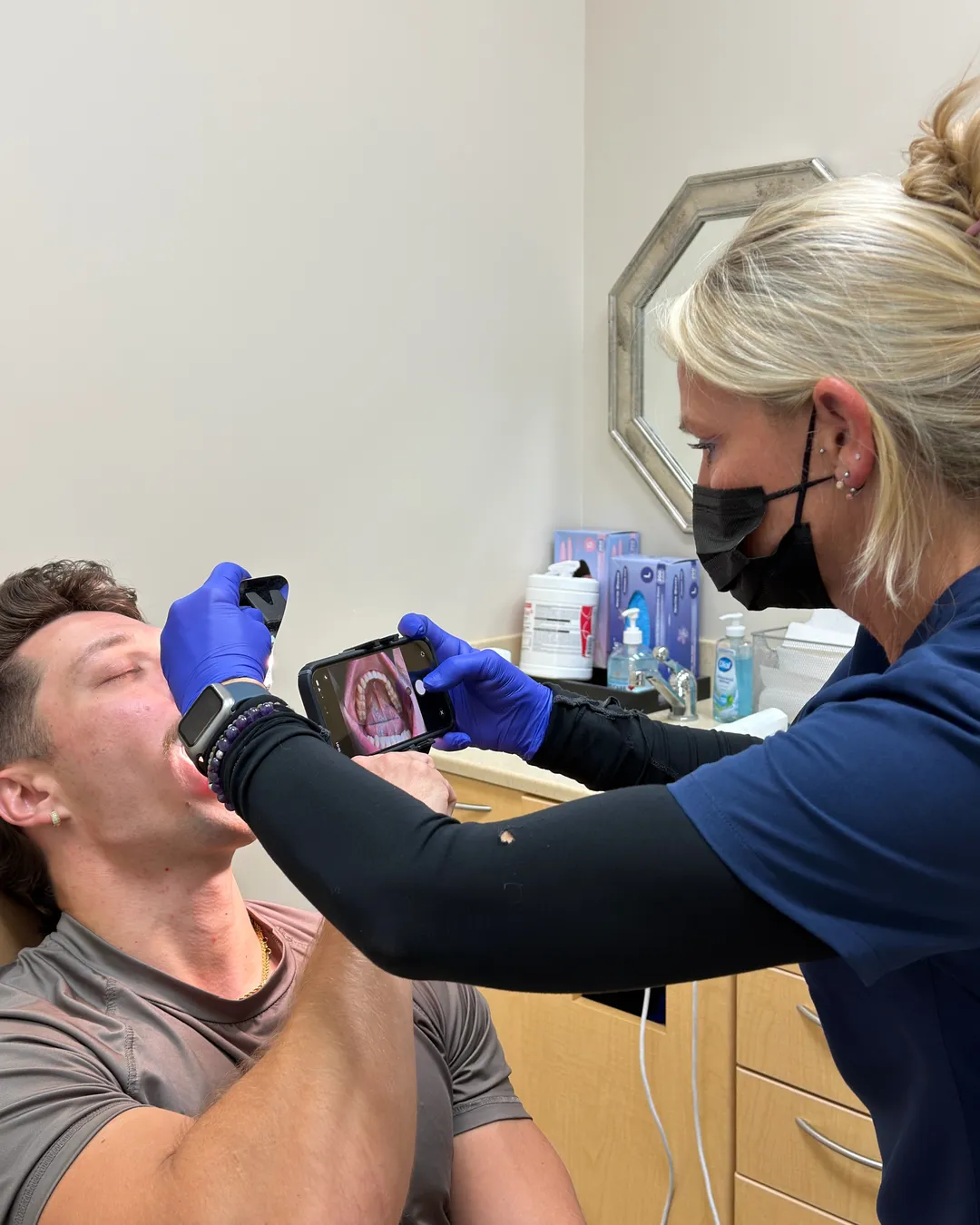
What an anterior open bite is. An anterior open bite is a bite where the back teeth meet but the upper and lower front teeth stay apart, leaving a gap you can see when you bite down. It's the open bite this page is mostly about, and with healthy gums and bone it can usually be treated at any age.
Dr. Ogden is an orthodontic specialist and a member of the American Association of Orthodontists, and he completed his orthodontic residency at the University of Florida.
Usually not. Tooth movement doesn't stop at a certain age, and most adult open bites can still close with braces or Invisalign when the gums are healthy and there's enough bone around the teeth.
Age on its own doesn't decide it, which matters in a town where 33.1% of residents are 65 or older, according to U.S. Census Bureau QuickFacts.
What age does change is the planning. An adult has no growing left to help, so the gap closes by moving teeth, and there's usually some dental work to plan around.
If your gums have receded or you've lost bone, they need to be healthy and stable first, and Dr. Ogden checks that before he talks about options.
Quick answer: back teeth together and front teeth apart usually means an open bite. A gap that's new or getting wider is the one to have looked at soon.
1. Who is this for?
2. What's going on with the front teeth?
Show my result
This quiz can't diagnose an open bite, and only an exam can, so treat your result as a starting point. Sudden jaw pain, a jaw that locks, or swelling with fever needs your dentist or doctor right away.
Dental work changes the plan, but it rarely rules treatment out. Each kind fits in a little differently.
Teeth with crowns can usually still be moved. Tell us about any crowns or veneers on your front teeth before you start, and Dr. Ogden checks them on your X-rays and photos.
An implant is fixed in the bone, so it can't be moved like a natural tooth. If one of your front teeth is an implant, braces or aligners can't bring it down to meet the bottom teeth, so the gap has to close by moving the natural teeth around it. That's why your X-rays matter before anything starts.
A bridge ties two or more teeth together, so they move as one unit. That limits some movements, and Dr. Ogden will tell you at the consultation what it means for your bite.
If your dentist already has a plan for a new crown, an implant or a bridge, bring it to the consultation and Dr. Ogden will work from it. There's more on treatment around dental work on our adult braces and Invisalign in Mount Dora page.
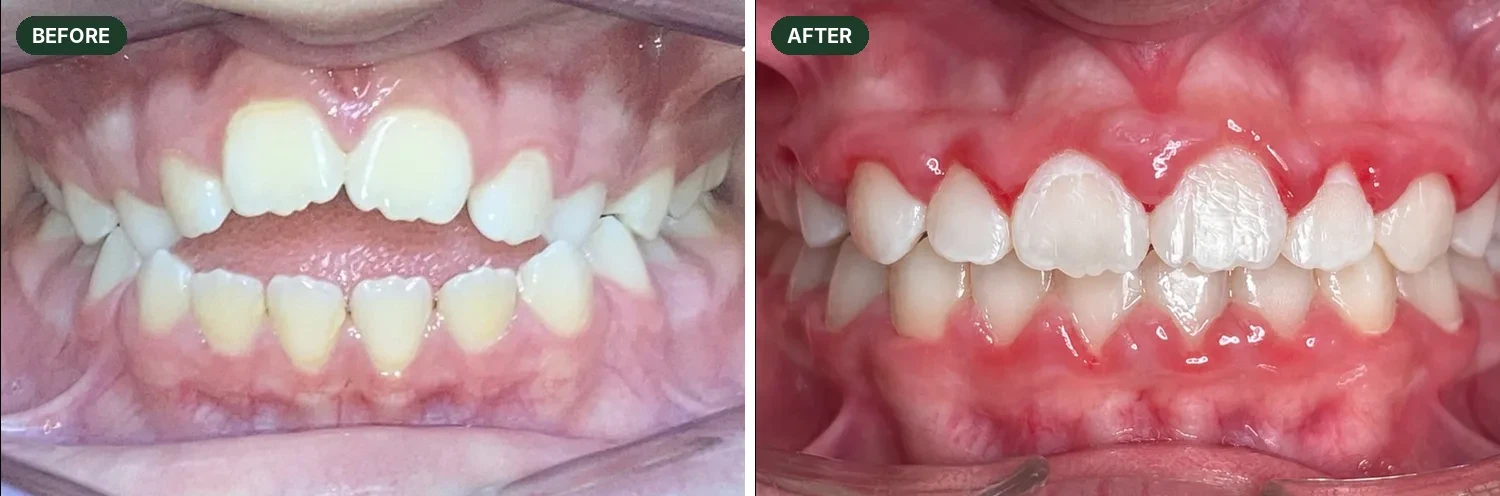
This is one of Dr. Ogden's open bite patients, shared with permission. The left photo shows the gap they lived with, back teeth together and front teeth apart, and the right photo shows the same bite after treatment with the front teeth meeting.
Your bite has its own cause and will need its own plan. At the free consultation you'll hear what's realistic for yours.
In adults, an open bite is usually left over from a childhood habit, kept open by the tongue, set by the shape of the jaws, or some mix of the three. Less often, it's a bite that used to close and started opening later in life.
A childhood habit that left its mark. A thumb or finger habit that lasted through childhood can leave the front teeth apart, and the gap can stay long after the habit ended.
The tongue. A tongue that rests against or between the front teeth can keep a bite from closing, or let a closed bite open again. Sometimes it's the cause and sometimes it moved into a gap that was already there, so Dr. Ogden checks how it rests and how you swallow.
If you also snore or breathe through your mouth, read about airway orthodontics in Mount Dora.
The shape of the jaws. Some open bites come from how the jaws grew, and these can run in families. A cephalometric X-ray, a side view of the jaws, shows whether that's part of yours.
A bite that starts opening later. A bite that used to close and begins to open in adulthood is the one to have checked soon, and your dentist or doctor may want to see it too.
An open bite can reopen after braces, and there's usually a reason. A tongue that rests forward and a retainer that stopped getting worn are common ones, and less often a change in the jaw joints plays a part.
Bring your old retainer, even if it no longer fits, and a photo from the day your braces came off if you have one. Tell Dr. Ogden what dental work you've had since, because a new crown, an implant or a missing tooth can change what the plan needs.
If the change is small, Invisalign Touch-Up is $2,495 and usually takes under 6 months. If the bite has fully reopened, you're looking at a full plan with braces at $4,550 or Invisalign Comprehensive at $4,895.
For most adults and teens, braces or Invisalign close the gap. What changes the choice is how the bite opened, whether there's dental work, and whether the jaws are part of it.
Braces here are self-ligating, in metal or clear ceramic, and the brackets go on by indirect bonding from a model of your teeth. Nothing comes out between visits, so there's no wear schedule to keep. Read more about braces in Mount Dora.
Invisalign is hard to spot and comes out to eat, but it only works while you're wearing it, so plan on 20 to 22 hours a day. Read more about Invisalign in Mount Dora.
For many adults, no. Many close an open bite with braces or Invisalign alone, and surgery comes up only when the gap comes mainly from the jaws and is too large for moving teeth to fix well.
If your X-rays point that way, Dr. Ogden will tell you at the consultation and explain how an oral surgeon would fit into the plan. Nothing is decided that day, and you'll hear whether braces alone could still get you a good result.
Children and teens are treated here too, whether a parent or a grandparent brings them in. By about age 7 is when the American Association of Orthodontists suggests a first orthodontic visit.
If your child or grandchild has a thumb habit or a gap in the front teeth, the first visit is a free look at what's going on.
When early treatment is needed, it usually starts around 8 or 9 and lasts 6 to 12 months. Depending on the child, it can involve an expander, and sometimes limited braces or a habit appliance. Read more about early orthodontic treatment.
For teens, braces or Invisalign usually close the gap, with braces visits every 6 to 8 weeks.
The consultation takes about 30 minutes, it's free, and you don't need a referral. You leave knowing what's holding your front teeth apart and whether treatment makes sense.
What to bring. Your insurance card, your old retainer if you have one, and any notes or treatment plans from your dentist.
What Dr. Ogden checks. Your bite, how your tongue rests, and your dental work. The panoramic X-ray maps every tooth, crown and implant, and the cephalometric X-ray shows whether your jaws are involved.
What you leave with. One of three answers: treat it, watch it, or leave it alone. If treatment is worth doing, you get the plan and the price on paper.
Closing an open bite at our Mount Dora office costs $4,550 with braces or $4,895 with Invisalign Comprehensive. A small reopening after earlier braces may only need Invisalign Touch-Up at $2,495, and a child's early treatment is typically $750 to $1,800.
The consultation costs nothing, and our Mount Dora, Clermont and Windermere offices all charge the same fees. Records, adjustments, repairs and your first retainers are all part of the braces fee, and it doesn't change if treatment runs longer.
Invisalign Comprehensive comes with three refinements, and any extra refinement is $500.
Orthodontic benefits differ from plan to plan, so our front desk checks yours before you commit. We regularly work with Delta Dental, DeltaCare USA, Cigna, MetLife, United Healthcare, Ameritas and The Standard.
You can spread the cost over 12, 18 or 24 months with our 0% in-house financing. Braces with $300 down over 24 months work out to about $177 a month.
Cherry, a separate company, also offers financing based on approval. We have military discounts, and HSA and FSA funds can generally be used for orthodontic treatment.
The office is on North Donnelly Street, about a mile north of downtown Mount Dora, in town rather than out on the highway.
Patients from Eustis and Tavares come in on US-441, and Sorrento and Mount Plymouth patients come over on SR-46. Zellwood patients make the trip too.
2110 N Donnelly St, Suite 700, Mount Dora, FL 32757
Monday through Friday, 8:00 am to 5:00 pm
Front teeth that overlap too deeply are a different problem, covered on our overbite treatment in Mount Dora page.
Closer to Orange County? Dr. Ogden also offers open bite treatment in Windermere, and switching offices partway through keeps the same doctor and the same plan.
You can meet the team on the Mount Dora orthodontist page.
Yes. Dr. Robert Ogden treats open bites in adults, teens and children at 2110 N Donnelly St in Mount Dora, where he has practiced since 2006. The consultation is free, needs no referral, and patients come from as far as Umatilla and Grand Island.
It depends on what's holding the teeth apart and how old you are. For most teens and adults it's braces or Invisalign, and a child with a habit may need early treatment or a habit appliance. For a few adults whose gap comes from the jaws, braces paired with jaw surgery works better, and the X-rays at the free visit show which applies to you.
It often is if you can't bite through food with your front teeth, a lisp never went away, or your dentist sees wear on your back teeth. If the gap doesn't bother you and your dentist sees no wear, Dr. Ogden will say so, and leaving it alone is a fair choice.
Braces are $4,550 and Invisalign Comprehensive is $4,895, with 0% in-house financing over up to 24 months. If your bite only opened a little after earlier braces, Invisalign Touch-Up is $2,495.
Often, yes. Crowned teeth can usually be moved, but an implant can't be moved like a natural tooth, so the gap has to close with the teeth around it. Your X-rays and your dentist's notes show what's possible.
Usually only a little. Braces and Invisalign mainly change how the teeth meet and how the lips rest, and bigger changes to the face come with jaw surgery, which only a few adults need.
It can be for the few adults whose X-rays show a gap that comes mainly from the jaws. Then surgery with braces may close the bite better than braces alone, and Dr. Ogden goes over both routes with you before anything is decided.
You'll feel pressure and some soreness, at any age. Expect a few tender days after braces go on and after each adjustment, and some pressure with each new set of aligners, and soft foods help for a day or two.
Braces usually take 18 to 24 months here, with visits every 6 to 8 weeks. A small reopening treated with Invisalign Touch-Up usually takes under 6 months.
It can be. Open bites that come from how the jaws grew can run in families, while ones caused by a habit don't. Mention it if a parent or sibling has the same bite.
Yes. A retainer is a big part of keeping the bite closed, along with dealing with whatever opened it, like a tongue that rests forward. The braces fee includes your first set, and a replacement costs from $225.
Picture biting into a piece of toast with your front teeth instead of turning your head to the side. Picture your dentist planning that crown or implant around a bite that closes.
It starts with half an hour on North Donnelly Street, and you leave knowing what's keeping your teeth apart and what it takes to close the gap.

Reviewed by Dr. Robert Ogden, DDS (Case Western Reserve University), orthodontic specialist and member of the American Association of Orthodontists, orthodontic residency at the University of Florida. Last reviewed November 16, 2026.
