


Open bite orthodontist in Windermere
You can't bite through a slice of pizza or a lettuce leaf with your front teeth, because they never meet, so you tear it off with your side teeth. Or your 7-year-old's front teeth don't touch, and the thumb habit hasn't stopped.
Dr. Robert Ogden has been closing open bites since 1995 for families in Windermere, Horizon West, Winter Garden, Gotha and Dr. Phillips. Open bite treatment in Windermere starts with a free 30-minute visit at 1805 Maguire Rd, where he works out what's keeping the front teeth apart: a habit, the tongue, or the way the jaws grew.
Most open bites close with braces or Invisalign, without jaw surgery. If treatment makes sense, you leave with the plan and the price in writing.
Free, no referral, and no decision needed that day.
Here is a real open bite before and after from Dr. Ogden's practice, shared with permission. Before treatment, on the left, this patient's front teeth didn't meet even with the back teeth together. After treatment, on the right, they close.
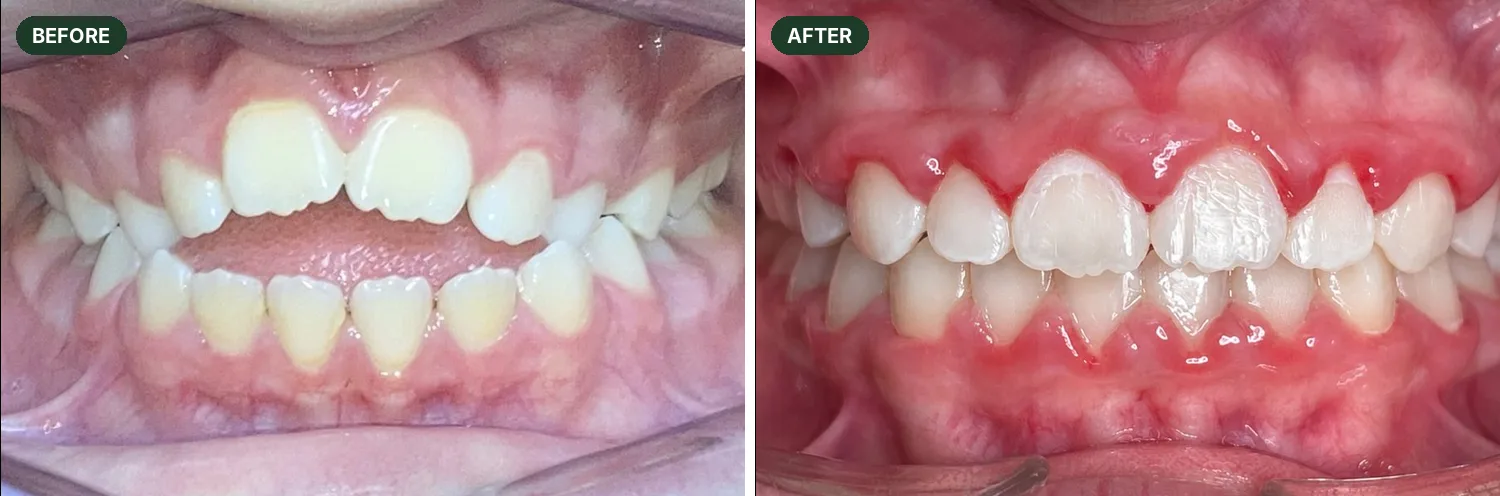
Every open bite has its own cause, so one patient's result doesn't predict yours. The consultation tells you what's realistic for your bite.
Open bite teeth are teeth that don't meet when you close your mouth, and an open bite is one of the main types of malocclusion, or bad bite.
The front teeth don't overlap or touch, and you can see a space between them when you bite. This is the kind most people mean, and the kind this page is mostly about.
The back teeth on one or both sides don't meet, while the front teeth do. It's less common, and it can make chewing on that side harder.
An open bite can hide well. The smile can look fine from the front until you bite down.
Take the 30-second quiz
Quick answer: if your front teeth don't touch when your back teeth are closed, you may have an open bite. Trouble biting into food, a lisp that never went away, or a gap that came back after braces are all good reasons for a free look.
1. Who is this for?
2. What have you noticed?
3. Is a thumb, finger, pacifier or tongue habit part of it?
A tongue that rests between the front teeth counts.
You'll see what we'd suggest for your bite.
These answers only point you to a next step, and only an exam can diagnose an open bite. If a front tooth has been knocked loose or out, call your dentist right away.
An open bite is usually caused by a thumb, finger or pacifier habit, a tongue that rests forward, or the way the jaws grew, and many have more than one cause. The cause decides the plan, which is why Dr. Ogden starts there.
A thumb that sits between the front teeth for years can hold them apart, narrow the upper jaw and push the top front teeth forward. In young children, stopping the habit is often the first step.
Some open bites have nothing to do with habits. The jaws grew in a way that leaves the front teeth apart, and these bites can run in families.
Breathing through the mouth is linked to how the jaws and tongue develop, too. If your child snores or sleeps with their mouth open, read about airway orthodontics in Windermere.
Where the tongue rests matters more than most people think. A tongue that sits against or between the front teeth for hours a day puts light, steady pressure on them, and that can keep a bite open or let it reopen after braces.
A tongue that pushes forward when you swallow is often filling a gap that's already there. So Dr. Ogden looks at where your tongue rests, not just how you swallow.
Most people have no idea their tongue does this. That's why it gets checked before treatment starts, so the plan and the retainer are chosen with it in mind.
Where the tongue sits. When your child is relaxed, watching TV or asleep, check whether the tip of the tongue shows between the front teeth.
Who else has it. If a parent or sibling has the same bite, mention it at the visit.
A photo with the back teeth closed. It shows the gap better than anything else, and it's the most useful picture to send with a virtual consultation. Photos can't show the jaws, so plan on the in-office visit for the full answer.
This is the question that decides most open bite plans. A cephalometric X-ray, a side-view picture of the jaws, is how Dr. Ogden tells the two apart.
Many open bites are a mix of both. Besides the X-ray, Dr. Ogden looks at:
If your child is young and the habit is already fading, Dr. Ogden may tell you to wait, since a mild open bite sometimes closes on its own.
If your 6 or 7 year old's new front teeth are still coming in, a small gap can be part of that, and he may tell you to give it time.
What works depends a lot on age, because a growing child's jaws can still be guided and an adult's can't.
The American Association of Orthodontists recommends a first orthodontic visit by about age 7. For most children with an open bite, that visit is mostly watching, and you'll know whether to come back in a year or step in sooner.
When a thumb habit is still going and changing the shape of the bite, early treatment, usually starting around 8 or 9, can help stop it. That may include a habit appliance, a small device behind the top teeth that makes the habit hard to keep up. Read more about early orthodontic treatment.
Yes, a teen or adult open bite can be fixed. Teeth move at any age, so most are closed with braces or Invisalign.
Teens usually still have some growing left. Adults don't, so for them the fix comes from moving the teeth. If your teen plays a sport, ask about an Orbit mouthguard at the consultation.
Usually not. Most open bites are closed with braces or Invisalign alone.
Open bite jaw surgery comes up for some adults whose open bite comes from the shape of the jaws and is too large for braces to close well. It's done by an oral surgeon alongside braces, and the surgeon bills for it separately.
Dr. Ogden brings up surgery only when braces alone can't get you a good result. For the adults who need it, it's a bigger step, and it's the treatment that can change the jaw itself.
Usually not much. Braces and Invisalign mainly change how the teeth meet, and the face itself changes little.
If the top front teeth also stick out, bringing them back can change how the lips sit. Bigger changes to the face come with jaw surgery, which only a small number of adults need.
An open bite can reopen, so the second plan starts by finding out why. A tongue that rests forward, a retainer that stopped getting worn, and jaws that kept growing after braces can each play a part.
The fix depends on how far it opened. A small change in the front teeth may only need Invisalign Touch-Up at $2,495, usually under 6 months. A bite that has opened up again needs a full plan with Invisalign Comprehensive at $4,895 or braces at $4,550.
A retainer holds the teeth where they end up, and replacements start at $225. Knowing what reopened the bite the first time is what gives the second result its best chance.
Braces and Invisalign can both close many open bites. Neither one changes the jaws, so for a bite that comes from how the jaws grew, the question is how much moving the teeth can do, not which appliance does it.
Our braces are self-ligating brackets in metal or clear ceramic, placed by indirect bonding from a model of your teeth. Read more about braces in Windermere.
Invisalign is hard to spot and comes out for meals, and it only works if you wear it. Read more about Invisalign in Windermere.
Either one may use rubber bands to help bring the front teeth together, and your plan will say whether you need them.
Bring your insurance card, and any notes your dentist gave you about your bite.
Windermere office
Half an hour, no referral, and you leave knowing what's holding your front teeth apart and what it costs to close the gap.
Fixing an open bite at Ogden Orthodontics in Windermere usually costs $4,550 with braces or $4,895 with Invisalign Comprehensive. A child's early treatment is typically $750 to $1,800, and a small reopening after braces may only need Invisalign Touch-Up at $2,495.
The consultation is free, fees are the same at all three offices, and you get the price in writing before you agree to anything. Jaw surgery, for the few adults who need it, is billed separately by the oral surgeon.
The braces fee includes records, adjustments, repairs and your first retainers, and it doesn't go up if treatment runs long. Invisalign Comprehensive includes three refinements, and extra ones are $500 each.
Many adult dental plans leave out orthodontics, and plans that include it usually set a lifetime maximum. Our front desk checks your benefit before you commit. We regularly work with Delta Dental, DeltaCare USA, Cigna, MetLife, United Healthcare, Ameritas and The Standard.
In-house financing is 0% interest over 12, 18 or 24 months, so braces with $300 down over 24 months come to about $177 a month. Cherry, a separate company, offers financing with terms that depend on approval, and we have military discounts. Orthodontic treatment is generally eligible for HSA and FSA funds.
Our Windermere office is at 1805 Maguire Rd, about two miles south of Highway 50, near the Park Ridge Gotha Road intersection, with parking on site.
Families come from around the Butler Chain of Lakes and across West Orange County: Horizon West and Winter Garden to the west, Gotha and Ocoee to the north, and Dr. Phillips to the east. You can switch between our three offices during treatment without changing doctors or plans.
1805 Maguire Rd, Suite 101, Windermere, FL 34786
Monday through Friday, 8:00 am to 5:00 pm
If your front teeth overlap too much rather than too little, see overbite treatment in Windermere. Closer to Clermont or Mount Dora? Dr. Ogden sees open bite patients at all three offices, and there's more about our team on the Windermere orthodontist page.
Yes. Dr. Robert Ogden treats open bites in children, teens and adults at 1805 Maguire Rd in Windermere, a short drive from Ocoee, Winter Garden and Horizon West. He has treated Windermere families since 1995, and the consultation is free and needs no referral.
Braces for an open bite are $4,550 at our Windermere office, and Invisalign Comprehensive is $4,895, with 0% in-house financing. Early treatment for a child is typically $750 to $1,800.
It depends on the cause. A habit in a young child may only need the habit to stop, sometimes with a habit appliance. Most teen and adult open bites are closed with braces or Invisalign, and a few adult bites that come from the jaws do better with jaw surgery alongside braces. A 2014 Cochrane review found too little research in children to name one best method.
Usually, yes. Most open bites are closed with braces or Invisalign alone, and the consultation tells you if yours is one of the few that may need surgery.
Often, yes. Invisalign Comprehensive closes many open bites, as long as it's worn 20 to 22 hours a day. Like braces, it moves teeth rather than jaws, so a bite that comes mostly from the jaws has the same limits either way.
Most braces cases at our office take 18 to 24 months, with a visit every 6 to 8 weeks. Early treatment for a child usually lasts 6 to 12 months. Your timeline depends on how wide the gap is and what's causing it.
It is when biting into food is hard, a lisp hasn't gone away, or your back teeth are taking more of the work than they should. If none of those apply, it's a personal choice, and how it looks is a fair reason too.
Sometimes, in young children. A mild open bite from a thumb or pacifier habit can close once the habit stops while the child is still growing. In teens and adults it usually doesn't close on its own.
Usually not much. Braces and Invisalign change how the teeth meet more than the face itself, and jaw surgery is the treatment that can change the profile.
It can help, but it isn't guaranteed. Closing the gap can make "s" and "th" sounds easier, and if the lisp stays after the teeth are closed, a speech therapist is the person to see.
For an adult whose open bite comes from the jaws and is too large for braces to close well, it can be. It's a bigger step with its own fee, so you'll hear first whether braces alone can get you a good result.
Yes. Open bites are among the bites most likely to reopen, so wearing a retainer matters. Your first set is included with braces, and replacement retainers start at $225.
Picture biting straight through your food with your front teeth, and smiling in photos without thinking about the gap.
It starts with half an hour on Maguire Road, and a clear answer about what's causing it and what it takes to close.

Free, about 30 minutes, no referral needed.
Reviewed by Dr. Robert Ogden, DDS (Case Western Reserve University), orthodontic specialist and member of the American Association of Orthodontists, orthodontic residency at the University of Florida. Last reviewed November 16, 2026.
