


Airway orthodontics in Mount Dora
Snoring, an open mouth at night, a narrow smile. Find out for free whether your child's jaw is part of it.
Dr. Robert Ogden, an orthodontist in Central Florida since 1994, checks children's jaws and bites at our Mount Dora office on North Donnelly Street. When a narrow upper jaw is part of the problem, he treats it with the Leaf Self-Expander for $1,050. When it isn't, he tells you so, and he won't sell you an expander for breathing.
No referral needed, and nobody pushes you to decide that day.

You can hear the snoring through the bedroom wall. Your child's mouth hangs open at the dinner table, in the car and on the pillow. They sleep ten hours and still drag themselves to the bus stop.
Online, you'll find plenty of people promising an expander fixes all of it.
Dr. Ogden's view is more careful. In some children, a narrow upper jaw leaves less room to breathe through the nose, and widening it can help. In plenty of others, the snoring has nothing to do with the jaw. One visit tells you which one you're dealing with, and what to do next either way.
Snore yourself? Dr. Ogden also offers the Silent Nite sleep appliance for adults, $625 to $1,200. See the options for adults.
Airway orthodontics is orthodontic care that pays attention to how the shape of the upper jaw affects breathing, along with how the teeth line up. It isn't a separate specialty. It's a regular orthodontic exam with the breathing question asked.
Here's why the two are connected. The palate your child's top teeth sit on is the same bone that forms the floor of the nose. A narrow palate tends to crowd the teeth or push the back teeth into a crossbite. In some kids it also narrows the nasal floor and leaves the tongue without a good place to rest, so breathing through the mouth gets easier than breathing through the nose.
Take the two-minute check
Quick answer: if your child has a narrow smile, crowded teeth or a crossbite along with snoring or mouth breathing, a jaw check is a reasonable next step. If you've seen pauses or gasps in their sleep, call your pediatrician first. Answer four questions to see what we'd suggest for your family and what to bring to your visit.
1. Who are you asking about?
2. What have you noticed most?
3. When is it worst?
4. Has a doctor looked at the breathing side yet?
You'll see what we'd suggest for your family and what to bring to your visit.
This check is a starting point, not a diagnosis. Dr. Ogden decides after he examines the jaw, and if nothing needs doing, he tells you that. If anyone is struggling to breathe, call 911 or go to the nearest emergency room.
Some problems live in the jaw itself: an upper jaw that's too narrow for the lower one, back teeth biting in a crossbite, or front teeth crowding because the arch has run out of room. Those have orthodontic fixes. Widening the upper jaw gives the teeth space and lines the bite back up.
If that same narrow jaw was squeezing the nasal floor, easier nose breathing can come along with it. Dr. Ogden is careful about the order. The jaw is the reason he treats. Better breathing is something that may follow, and he won't promise it.
Sleep apnea is diagnosed by a physician, usually with an overnight sleep study. The American Association of Orthodontists says an orthodontist's job is to notice warning signs, send you to a physician, and help with treatment when that physician agrees it fits.
Enlarged tonsils and adenoids are behind a lot of childhood snoring. When a child has sleep apnea along with enlarged tonsils or adenoids, the 2012 American Academy of Pediatrics guideline recommends taking them out as the first treatment. An expander doesn't treat tonsils.
Expansion does have a place in the guidelines. A 2024 American Thoracic Society guideline, summarized by the American Academy of Family Physicians, says orthodontic treatment can be considered for some children, typically ages 6 to 13, whose sleep apnea is still there after tonsil and adenoid surgery and who have a narrow upper jaw. The guideline rates the evidence as very low certainty and the suggestion as conditional. It doesn't support expanders as a general fix for snoring.
Central Florida's oak trees put out heavy pollen in late winter and spring. A stuffed-up nose can turn any child into a mouth breather for weeks at a time.
If the open mouth and snoring come and go with the seasons or with colds, allergies may be a big part of it, and that's a question for your pediatrician. If they hang around all year and the teeth are crowded or the bite is off, the jaw deserves a look.
He starts by listening, because you've watched your child sleep and he hasn't. Then, in the chair, he looks at three things:

Dr. Ogden checks the jaw and bite himself, with the X-rays up on the screen.
A healthy jaw can still belong to a child who snores. Big tonsils or adenoids, allergies and a congested nose can all keep the mouth open at night.
If the jaw width and bite look normal, Dr. Ogden tells you so, and he won't suggest an expander as a breathing fix. You skip paying for an appliance he doesn't expect to help, and you leave knowing your pediatrician or an ear, nose and throat doctor is the right next call.
Some kids have both problems at once, enlarged tonsils and a narrow jaw. Each gets handled by a different doctor, and Dr. Ogden can help you work out when the orthodontic part should happen.
The Leaf Self-Expander is a palate expander with no key to turn. Two nickel titanium springs shaped like leaves widen the upper jaw on their own, usually over 3 to 6 months. Dr. Ogden uses it when a narrow upper jaw needs widening.
You may remember the older kind of expander, where a parent turns a tiny key in the child's mouth every night. The Leaf, made by the Italian orthodontic company Leone, has nothing to turn at home and nothing to reactivate at the office.
We 3D print the metal frame from a digital scan of your child's mouth, so it fits snugly. It takes two visits to our Mount Dora office: a scan first, then the expander goes in at the second visit. No separators, the little rubber spacers some expanders need.
How long it stays in depends on how much widening the jaw needs. Dr. Ogden checks how it's going at your child's regular visits.
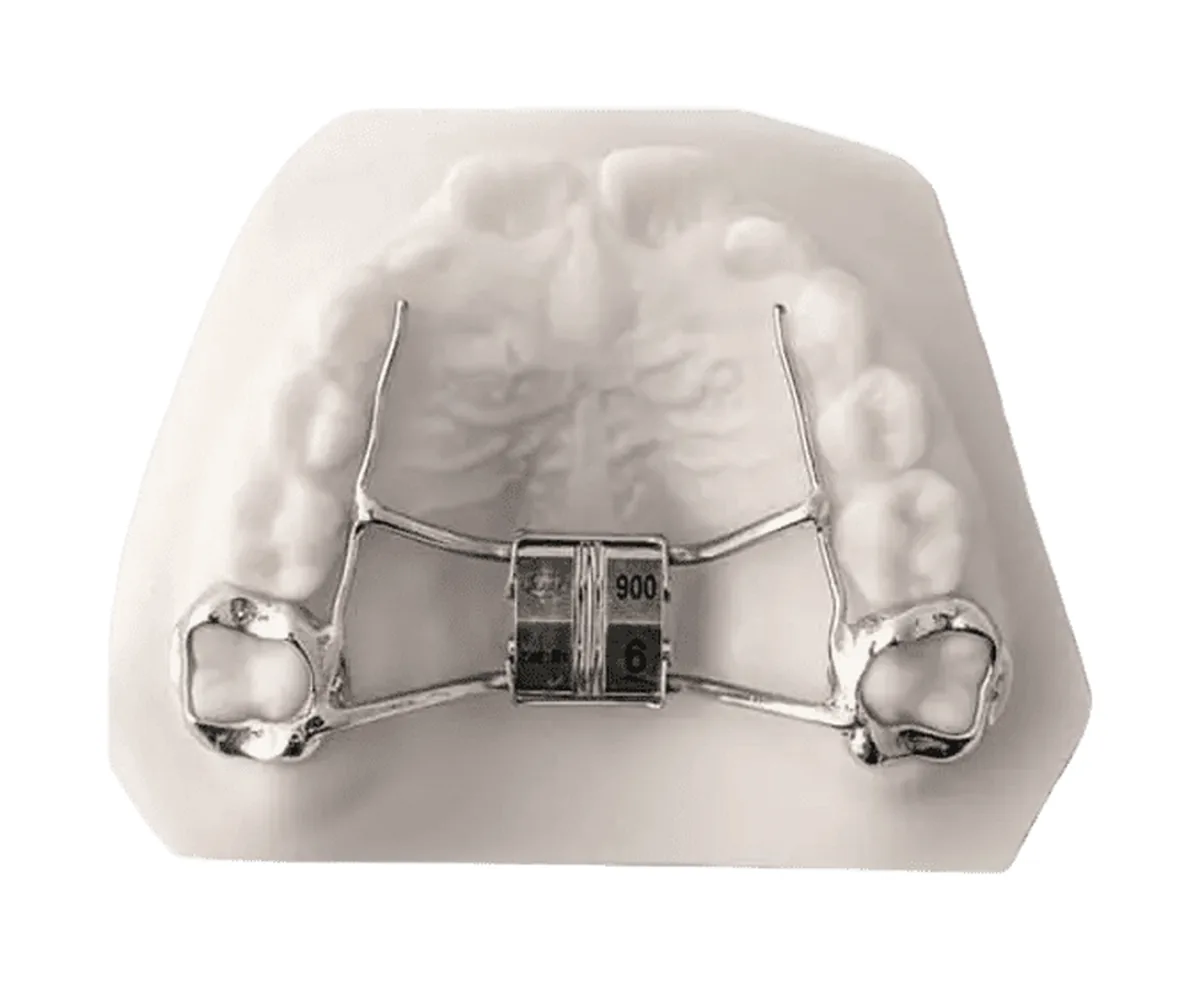
The Leaf Self-Expander widens the upper jaw with two nickel titanium springs.

A digital scan replaces the old impression trays, and the expander frame is 3D printed from it.
An animation of how the Leaf Expander works.
Expect a few days of pressure once it's in. Talking and chewing can feel strange for about a week while your child gets used to it.
A gap between the two front teeth can show up as the jaw widens. That's expected.
Small studies found the Leaf Expander made about as much room in the nose and upper throat as a traditional key expander, but none of them measured sleep.
The studies, from Italy, mostly followed children around 7 to 9. 3D scans showed the nasal cavity and upper throat got roomier with both expanders, with no significant difference between them. Two more studies looked at nasal width and changes to the jaw and teeth and found the same.
Small studies can't prove the two always perform the same. They also tested the original Leaf Expander, not the newer Self-Expander version Dr. Ogden uses.
Plenty of kids who need expansion go on to braces in Mount Dora or Invisalign in Mount Dora later to finish straightening the teeth.

The cephalometric X-ray, a side view that shows how the upper and lower jaws line up.
Plan on about 30 minutes. Nobody will push you to decide that day.
Can't get in this week? Send a few photos of your child's teeth and our team will follow up with what Dr. Ogden sees. Photos show the teeth and bite, not the reason a child snores, so the visit is still where you get the real answer.
Mount Dora office
The jaw check is free, takes about half an hour and needs no referral. You leave knowing whether an expander makes sense, or who to call next.
Sometimes the snoring is yours. Dr. Ogden treats adults too, in two ways.
For adults who snore or have mild to moderate sleep apnea, Dr. Ogden offers the Silent Nite from Glidewell. It's a custom mouthpiece you sleep in. It eases your lower jaw a little forward so your airway is less likely to collapse during the night, and you take it out in the morning. It's adjustable, so the fit can be fine-tuned.
Your first stop is a sleep physician. Under the 2015 oral appliance guideline from the American Academy of Sleep Medicine and the American Academy of Dental Sleep Medicine, the physician diagnoses snoring or sleep apnea and prescribes the appliance, and a dentist or orthodontist makes and fits it.
For sleep apnea, CPAP is often the first treatment a physician suggests. The same guideline supports an oral appliance for adults who can't tolerate CPAP or would rather use something else. It also calls for a follow-up visit with your physician, sometimes with another sleep test, to make sure the appliance is working.
We don't order sleep studies ourselves. Already had one? Bring the results to your consultation. Need one? Our office can put you in touch with a company that handles sleep testing.
The Silent Nite costs $625 to $1,200.
Some adults with a narrow upper arch can also be treated with the Leaf Expander.
Once growth finishes, the palate doesn't widen as easily, and expansion moves the teeth outward more than it spreads the bone. The Leaf Expander research so far was done in children, so Dr. Ogden will tell you what it can realistically do in your case.
A Leaf Self-Expander is $1,050 at our Mount Dora office, and the consultation that tells you whether your child needs one is free. You see the price in writing before you decide anything.
Many dental plans cover part of an expander. Orthodontic coverage usually comes as a lifetime maximum for each child, and our front desk checks your benefit before you commit. Delta Dental, DeltaCare USA, Cigna, MetLife, United Healthcare, Ameritas and The Standard are plans we work with regularly.
Paying over time? Our in-house plans carry 0% interest, and we also offer Cherry payment plans and military discounts.
Price in writing
Finding out whether your child needs one costs nothing, and our front desk checks your dental benefit before you commit.
You'll find us on North Donnelly Street, about a mile north of downtown Mount Dora and close to local schools. Families drive in from Tavares and Eustis on US-441, and from Sorrento and Mount Plymouth on SR-46. There's more about the office and our team on the Mount Dora orthodontist page.
2110 N Donnelly St, Suite 700, Mount Dora, FL 32757
Monday through Friday, 8:00 am to 5:00 pm
Dr. Ogden also sees patients in Clermont and Windermere, and families there can read about airway orthodontics in Windermere. Moving offices partway through treatment is fine, and you keep the same doctor and plan.
It's orthodontic care that considers breathing along with straight teeth. At Ogden Orthodontics in Mount Dora, Dr. Robert Ogden checks whether a narrow upper jaw might be playing a part in a child's snoring or mouth breathing, and tells families when it isn't.
Yes. Dr. Robert Ogden, an orthodontist since 1994, checks children's and adults' jaws for airway concerns at Ogden Orthodontics, 2110 N Donnelly St in Mount Dora. Families come from Tavares, Eustis, Sorrento and Mount Plymouth, and the consultation is free.
Common signs are a crossbite, crowded teeth, a high and narrow roof of the mouth, and breathing through the mouth. None of them confirms a narrow palate on its own. An exam and X-rays do.
In some cases. When a narrow upper jaw is the thing making nose breathing hard, widening it can help. Allergies and big tonsils or adenoids cause mouth breathing too, and those aren't orthodontic problems, so keep your pediatrician in the loop.
Yes, they can. Congestion from allergies or a cold makes nose breathing hard, and Central Florida's spring pollen makes that common here. If the mouth breathing comes and goes with the seasons, start with your pediatrician. If it never lets up, a jaw check is worth it.
Sometimes. Small studies found more room in the nose and upper throat after expansion, but none of them measured sleep. Dr. Ogden widens a narrow jaw because the jaw needs it. Easier breathing may follow, and he doesn't promise it.
Not on their own. According to the American Association of Orthodontists, orthodontists can't diagnose or treat sleep apnea by themselves. A physician makes the diagnosis, usually from a sleep study, and orthodontic treatment can be one piece of the plan if the physician agrees. Be wary of anyone who promises an expander will cure it.
For loud snoring or pauses in breathing, call your pediatrician first. They may send you to an ear, nose and throat doctor. If you've also spotted a narrow jaw, crowded teeth or a crossbite, book a free orthodontic consultation in Mount Dora to have the jaw checked at the same time.
By age 7, which is when the American Association of Orthodontists recommends a first orthodontic visit. For breathing concerns the timing matters, since the upper jaw widens most easily while the palate is still growing. Most 7-year-olds Dr. Ogden sees don't need treatment yet. Read more about early orthodontic treatment.
Not always. It depends on how much growing your teen has left, and Dr. Ogden checks that on the X-rays at the free consultation. As growth finishes, expansion moves the teeth outward more than it widens the jaw bone.
It's more pressure than pain. Most kids feel it for a few days after placement, and eating and talking feel odd for about a week. A gap between the front teeth can show up while the jaw widens, and that's expected.
Usually 3 to 6 months at Ogden Orthodontics in Mount Dora, with no key to turn at home. The exact time depends on how far the upper jaw needs to widen.
Tell Dr. Ogden about any metal allergy at the consultation. The Leaf Expander's springs are nickel titanium, so he'll talk through whether it's the right fit for your child.
$1,050 for a Leaf Self-Expander at Ogden Orthodontics in Mount Dora. Finding out whether your child needs one costs nothing, and many dental plans cover part of it.
Many do. The expander makes room, and braces or Invisalign often come later to finish straightening the teeth. Both are priced up front, and the expander fee is separate from any braces.
Yes. Adults who snore or have mild to moderate sleep apnea can get the Silent Nite sleep appliance at Ogden Orthodontics, and some adults with a narrow upper arch can get a Leaf Expander. A physician diagnoses sleep apnea first, usually with a sleep study.
In most cases, yes. The oral appliance guideline from the American Academy of Sleep Medicine and the American Academy of Dental Sleep Medicine has a sleep physician diagnose the problem and prescribe the appliance. We don't order sleep studies, but we can connect you with a company that handles sleep testing.
$625 to $1,200 at Ogden Orthodontics, depending on your case. The consultation is free, and our front desk will walk you through the price.
No. Book a free consultation at our Mount Dora office directly, without a referral from your dentist or pediatrician.
Picture next month. You know whether your child's jaw is part of the snoring. If it is, you have a plan and a price in writing while they're still growing. If it isn't, you know exactly who to call next.
Half an hour on North Donnelly Street is all it takes to find out.
