Mount Dora, Florida
Braces are not something you buy once. They are a standing appointment every six to eight weeks for about two years, and how the result turns out depends on who is in the room for all of them.
So there are two things worth settling before you book anything in Mount Dora. What it costs, and who you would be seeing for the next two years.
Braces at the Mount Dora office
$4,550 metal or clear ceramic
Down payments start at $300, which works out to about $177 a month over 24 months at 0% interest.
Your fee may be lower once an insurance benefit is applied. The exam and digital scan are free, and you leave with your price in writing whether or not you decide to start.
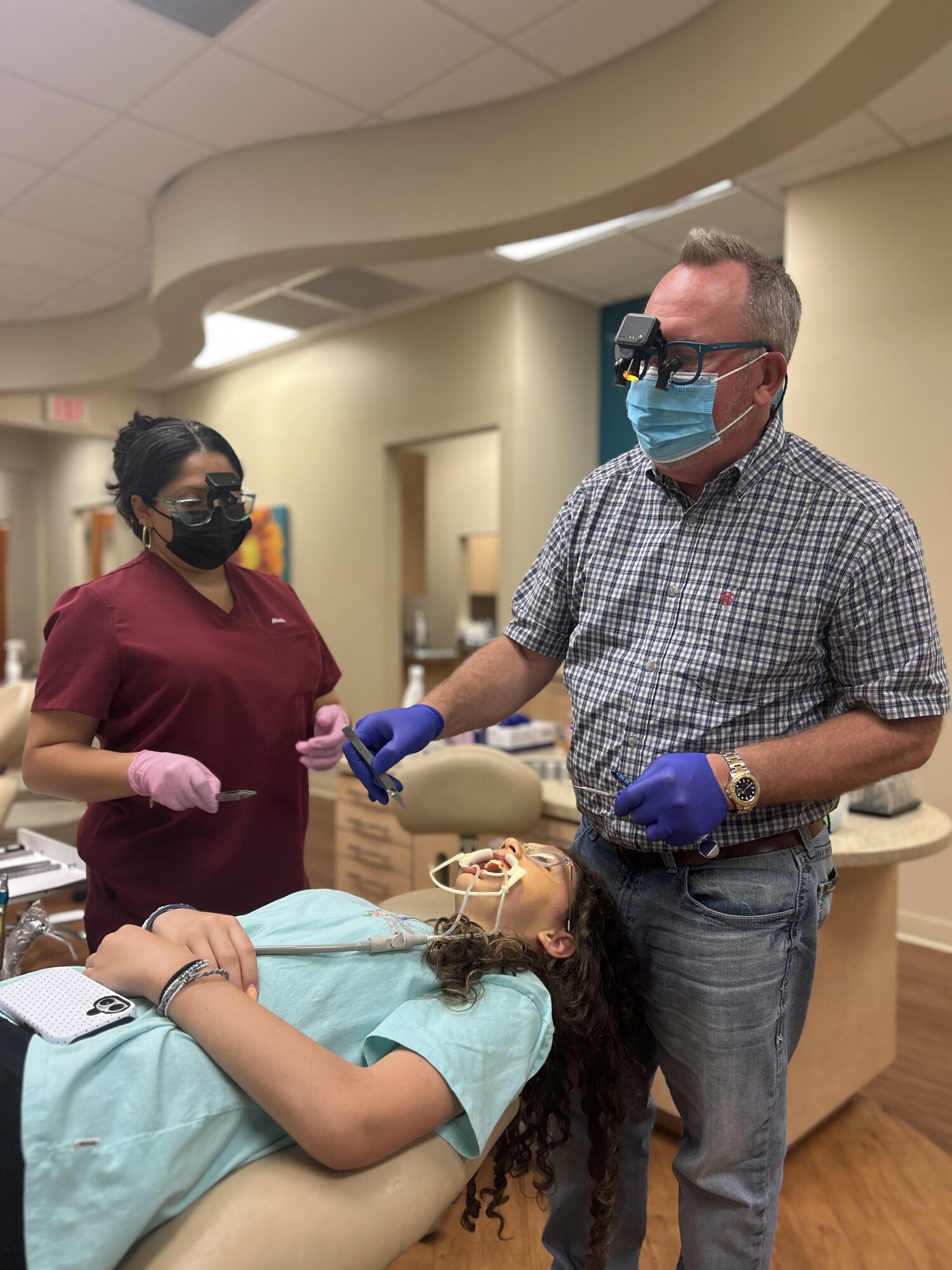
The answer to the second question is Dr. Robert Ogden. He opened the Mount Dora office on North Donnelly Street in 2006 and has treated here ever since, which is long enough that parents who had braces in this practice now bring their own children in.
He finished his orthodontic residency at the University of Florida in 1994 and has practiced nothing but orthodontics since. He is the only orthodontist across all three Ogden offices, so the person who plans your case is the one who bonds the brackets and the one who takes them off.
Worth reading before you sign anything, because these five lines are where expectations and reality usually come apart.
Everything on that list is normal orthodontics. The difference is having it in front of you before you commit rather than discovering it in month nine.
Most teenagers start braces once enough permanent teeth have come in. That lands anywhere from about eleven to fourteen, depending on how your child is developing rather than on a birthday.
What parents usually want to know is the practical side. Visits run about every six to eight weeks and most of them are short. The office is open Monday through Friday, 8:00 am to 5:00 pm, and the front desk works around a school schedule where it can.
Metal brackets are still what most teens choose, partly because the colored bands are the part they look forward to. Clear ceramic costs the same here, so a teenager who would rather the braces not be the first thing anyone notices is not asking you to spend more.
Often, yes. The American Association of Orthodontists puts the first orthodontic check at about age seven, and most seven-year-olds who come in need nothing done yet.
The point of that visit is to find the smaller number of cases where waiting makes the problem harder to fix. Certain crossbites and underbites, teeth that are not erupting where they should, or front teeth that protrude far enough to get injured easily.
If your child is not in one of those situations, Dr. Ogden will say so and put them on a watch schedule. Those monitoring visits are free.
If your child plays a contact sport, bring it up at the consultation so a mouthguard that fits over the brackets gets sorted before the season rather than after the first broken bracket.
Adults are a larger share of this office than most people expect, and the reasons repeat.
Teeth that drifted after a retainer quietly stopped getting worn. Lower front teeth that crowded a little more each year through someone's thirties. A bite that has started wearing the enamel unevenly, which a general dentist usually spots first.
Or having thought about it for fifteen years and deciding to be done thinking about it.
Mechanically it works the same at fifty as at fifteen. The difference is pace. Bone that has finished growing remodels more slowly, which can add a few months to a case, and most adults here ask for ceramic rather than metal. Ceramic is the same $4,550.
What decides whether an adult can start is the condition of the gums and the bone holding the teeth, not age. Dr. Ogden checks that at the consultation and will tell you plainly if something needs treating first.
That is one of the most common reasons adults come in here, and it is not a sign the first treatment failed. Teeth drift for life. The retainer is the whole answer to it, and relapse almost always traces back to the retainer stopping.
Relapse cases are often shorter and cheaper to correct than the original treatment was. If the movement is small, Invisalign in Mount Dora at $2,495 for Touch-Up may be all it takes, and that gets priced at the same free consultation.
One fee, quoted before anything starts, covering the whole of treatment rather than a number of months.
| Treatment | Fee | Usually chosen by |
|---|---|---|
| Metal braces | $4,550 | Most cases, including complex bite correction and younger patients |
| Clear ceramic braces | $4,550 | Adults and older teens who want the brackets less visible |
| Invisalign Touch-Up | $2,495 | Minor movement, usually finished in under six months |
| Invisalign Comprehensive | $4,895 | Full treatment, three refinements included |
Fees are shown before insurance. Yours may be lower once a benefit is applied.
Clear ceramic is the same price as metal here. Published ranges usually put ceramic a few hundred dollars above metal, so at this office the less visible option does not cost extra.
Replacement retainers after the first set, which start at $225.
Dental work that has to happen before brackets go on, such as extractions or fillings, billed by whoever does it.
Many dental plans carry an orthodontic benefit written as a lifetime maximum, often somewhere between $1,000 and $3,000 per patient. It applies once rather than every year, and adult coverage is frequently different from coverage for a child on the same plan.
This office works regularly with Delta Dental, DeltaCare USA, Cigna, MetLife, United Healthcare, Ameritas and The Standard.
Coverage varies by employer even within the same insurer, so bring your card and the front desk will check the specifics before you commit to anything.
Payment estimator
The fees above are real numbers rather than a range, so this is real math rather than an illustration. Move the pieces and see where the monthly payment lands.
An estimate, not a quote. Your fee is set after Dr. Ogden examines your teeth and goes in writing at your free consultation.
Get your written priceBraces are not the answer to every case, and Dr. Ogden will say so when they are not. These are the situations where they usually are.
A bracket and a wire push teeth through bone in a direction the orthodontist chooses. That is why brackets still win on the cases aligners fight, particularly a canine that has to be turned a long way or a bite that has to be opened or closed vertically.
Metal and ceramic carry the same fee at this office, so for most people the decision comes down to appearance rather than budget.
Steel brackets are noticeably smaller than they were a generation ago, and nothing moves teeth more predictably. They are the default for growing patients and for complicated bites, and the colored bands at each visit are the part most kids look forward to.
$4,550 Full treatment fee
Ceramic is tooth-colored, so at conversation distance and in photographs the brackets mostly disappear. The mechanics are identical to metal and so is the fee. Adults request these most, and so do teens heading into a year of school photos.
$4,550 Same as metal
A small built-in gate holds the wire rather than an elastic tie, which means less to swap out at each visit and, for some cases, fewer visits overall. Whether your case is one of those is a clinical call Dr. Ogden makes at the consultation.
Priced at consultation Depends on the case
Bracket positions get worked out on a model of your teeth ahead of time, then transferred to the mouth in one pass with a tray instead of being placed one at a time by eye.
You spend less time in the chair and the brackets end up where the treatment plan put them. It is the approach this office recommends and uses wherever a case suits it.
Two minute check
Three questions, then a starting point you can bring to your consultation at the Mount Dora office. Dr. Ogden makes the actual call after he looks at the bite.
Who is treatment for?
What bothers you most about the teeth right now?
How much does it matter that treatment is hard to notice?
You will get a starting point and a rough price for the option that usually fits, along with what to ask about at the consultation.
Eighteen to twenty-four months is the usual range, and your own estimate goes in writing next to the fee once Dr. Ogden has examined the bite. Nobody can give you that number over the phone.
Four things change how long it takes.
Missed appointments and skipped elastics are what usually push a case past its estimate, and you will hear about it early rather than at the end.
You go home with retainers the same day, and the first set is in the fee. Bone and gum tissue need months to firm up around teeth that have just been moved, and the retainer is what holds everything still while that happens. Replacements start at $225.
After that, teeth keep drifting for the rest of your life. Everyone's do. A few nights a week in a retainer is the entire defense against it, which is a small thing to ask of a two-year investment.
The consultation is free, it usually takes about half an hour, and there is no expectation that you start.
Dr. Ogden looks at the teeth and the bite and takes a digital scan. No charge, and no records fee before a decision.
The plan, the fee, the insurance estimate and the monthly payment go in writing before you leave.
Some people start the same week. Some take the quote home for a month and compare it against another office. Both are normal.
Dr. Ogden does the exam himself. A treatment coordinator walks you through scheduling and the financial side afterward, which is standard in orthodontic offices, but the diagnosis and the plan come from the doctor who would be treating you.
And if the case does not need treating yet, that is what you will hear. Come back in a year is a real answer here, not a soft no.
If you would rather not book a visit yet, send a few photos of your teeth and the Mount Dora office will follow up with what Dr. Ogden sees.
Book a free consultationFilmed at the chair
The part of the first visit people ask about most is the scan, usually because they remember a tray of putty from the last time they were in an orthodontic office.
That is not how records are taken here. A small wand passes over the teeth and the arch builds on the screen as it goes, which is what the clip is showing in real time.
It takes a few minutes, there is nothing to swallow or hold still for, and the model it produces is what the treatment plan and the bracket positions are worked out on.
A scan building on screen, filmed during a visit at an Ogden Orthodontics office.
Reviews from the Donnelly Street office, pulled live from Google.
2110 N Donnelly St, Suite 700
Mount Dora, FL 32757
(352) 735-0004
Monday through Friday, 8:00 am to 5:00 pm
The office sits on North Donnelly Street close to where it meets Highway 441, which puts it within a short drive of Eustis, Tavares, Sorrento, Zellwood, Tangerine and Umatilla.
Dr. Ogden treats at all three Ogden Orthodontics offices. If a job or a school run makes Clermont or Windermere easier for a stretch, you can be seen there without changing doctors or starting the plan over.
Schedule at Mount Dora$4,550 at the Mount Dora office, whether you choose metal or clear ceramic. That one number carries the whole case: all the adjustments, any repair work along the way, and your first set of retainers. It is quoted before insurance, so yours may be lower once a benefit is applied.
Financing is in house at 0% interest, with down payments starting at $300 and terms of 12, 18 or 24 months. A $4,550 case with $300 down works out to about $177 a month over 24 months.
An insurance benefit comes off the total first, which brings the monthly figure down further. The estimator above works it out for your own numbers.
Usually in part. Most plans that include orthodontics write the benefit as a lifetime maximum, often between $1,000 and $3,000 per patient, applied once rather than every year.
This office works regularly with Delta Dental, DeltaCare USA, Cigna, MetLife, United Healthcare, Ameritas and The Standard, and the front desk verifies your benefit before you commit to anything.
About every six to eight weeks once treatment is under way. Most adjustment visits are short. The two long ones are the appointment where the brackets go on and the appointment where they come off, each around an hour.
Orthodontic wax over the spot holds it until the office opens, then call and come in. It is not an emergency and it does not undo the progress.
Repairs to loose brackets and poking wires are included in the treatment fee rather than billed as extras, so a broken bracket costs you a trip down 441 and nothing else.
About three additional years of full-time residency after dental school, spent on tooth movement and bite correction and nothing else, followed by a career that stays on those two things.
A general dentist can legally offer braces and many good ones do. The difference is how much of the week goes into it. Dr. Ogden finished his residency at the University of Florida in 1994 and has treated nothing but orthodontic cases since, at an office that does no cleanings, fillings or crowns.
Yes. He is the only orthodontist across the three offices, so the doctor who plans the case is the one at every adjustment and the one who takes the braces off.
Staff handle scheduling and the financial side, which is how most orthodontic offices run, but the clinical decisions are his.
Usually, and often faster and cheaper than the first time. Bring the old retainer if you still have it.
Small relapse sometimes needs nothing more than Invisalign Touch-Up at $2,495. Larger movement is back to brackets. Which one applies gets decided at the consultation, and both get priced there.
Eighteen to twenty-four months for most people. A straightforward crowding case can be done sooner, and a bite that has to be rebuilt takes longer.
The estimate you get in writing at the consultation is based on your own bite rather than an average, and going past it does not change what you pay.
Sore rather than painful, and only in bursts. The day the brackets go on, and for a day or two after an adjustment, biting down feels tender. Ibuprofen and a few days of soft food cover it.
By the second or third adjustment most patients say they barely register it.
Yes, and families do it all the time. Dr. Ogden treats at all three, so your records and your plan follow you and the fee does not change.
It is worth knowing about before you start if work or school might move you across the county mid-treatment.
The bite decides, not the preference. Aligners are genuinely good at crowding, spacing and mild to moderate bite problems. Brackets hold their edge on badly rotated teeth, serious bite correction and anything needing a lot of vertical movement.
If both could work for your case, you get both priced at the same visit. Braces are $4,550 here and Invisalign in Mount Dora is $2,495 or $4,895.
Half an hour from now you could have an exam, a written fee, an insurance estimate and a timeline, none of which you had to piece together yourself.
And if braces are not the right call for your case, you will hear that instead. That is worth the half hour too.
Also at this office: Invisalign in Mount Dora · Mount Dora office details · Send photos instead
.png)