


Free early treatment evaluations
Someone has told you your child might need braces at 7 or 8. Maybe it was your dentist, maybe another orthodontist, and now you are trying to work out whether it is necessary or a sales pitch.
That is a fair question, and it deserves a straight answer. Most children do not need early treatment. A smaller group has a problem that really is easier to fix while the jaw is still growing.
Dr. Robert Ogden is an orthodontic specialist who has practiced in Central Florida since 1994. He will tell you which group your child is in, and if the answer is to wait, that is what he will recommend.
Early orthodontic treatment, also called phase 1 or interceptive treatment, is a first round of treatment done while a child still has some baby teeth. Its job is to correct a specific problem that is easier to fix while the jaw is growing, not to straighten every tooth.
Because it is aimed at one problem, the first phase is shorter and more targeted than full braces. Many children who have it still need a second phase once all of their adult teeth are in.
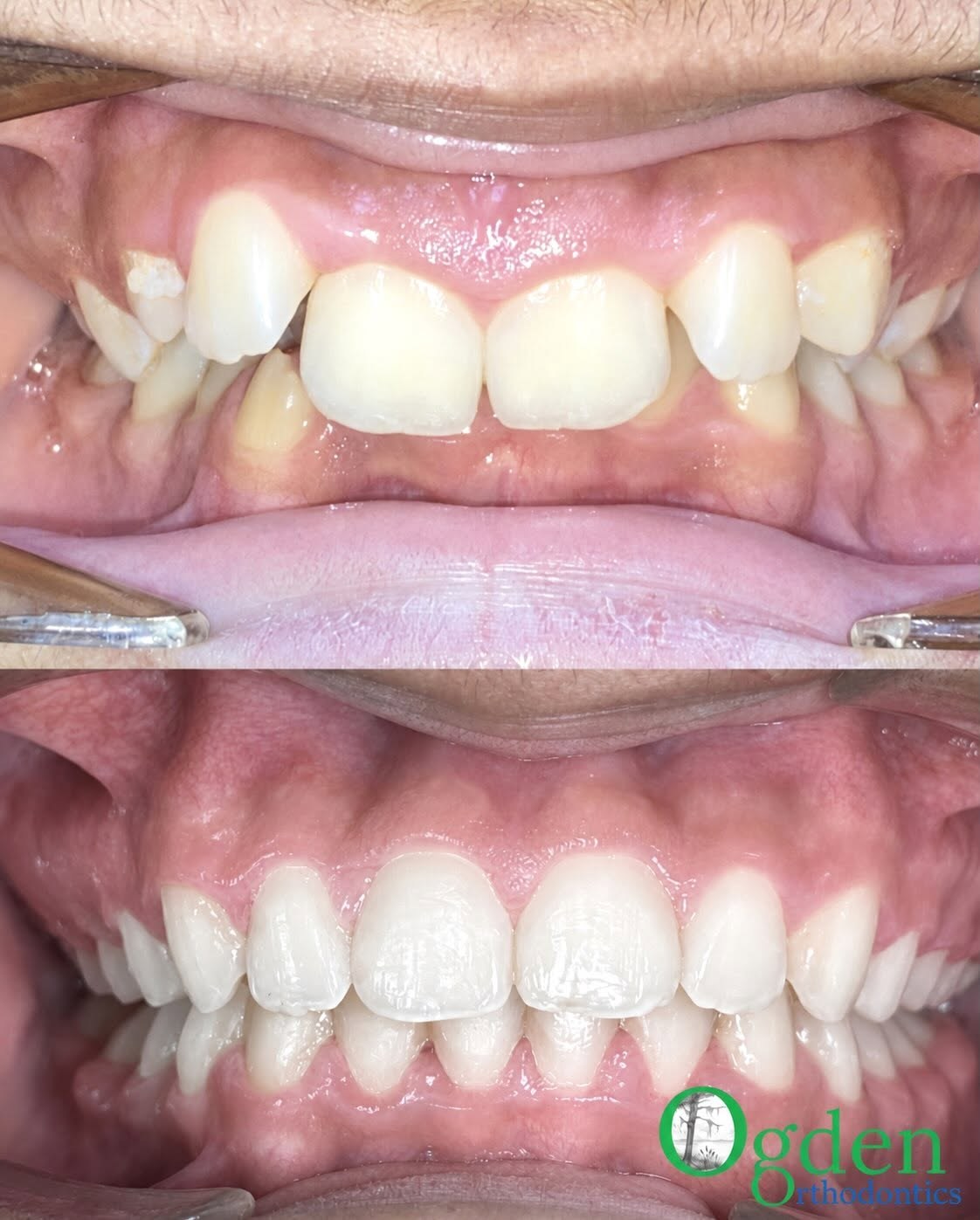
Crowded front teeth in a growing smile, before and after treatment at Ogden Orthodontics.
Probably not. Most children who come in around age 7 need nothing more than a check every so often while their adult teeth come in. Phase 1 is for a short list of problems where waiting makes the fix harder or less complete.
If your child's bite is not on the list below, the usual plan is to watch and wait. Those monitoring visits at Ogden Orthodontics are free.
A crossbite is when some upper teeth sit inside the lower teeth, often because the upper jaw is too narrow. Many kids shift their jaw to one side to bite down around it.
The roof of the mouth is easier to widen while a child is still growing. That makes a crossbite one of the clearest reasons to treat early.
An underbite is when the lower front teeth sit in front of the upper ones. Some underbites come from how the teeth are tipped and respond well to early treatment.
Others come from the jaws themselves, often an upper jaw that isn't growing forward enough. Those have a short window.
Treatment that guides the upper jaw works best before about age 8 or 9, according to Ohio State's chair of orthodontics. Left until the late teens, the same problem can take jaw surgery to correct.
Dr. Ogden will tell you which kind your child has before recommending anything.
Upper front teeth that stick out far, which orthodontists call a large overjet, are more likely to be chipped or broken in a fall. A 2018 Cochrane review found that treating them early cut new front-tooth injuries from 30% of children to 19%.
The same review found the final result was about the same as treating once in the teen years. So early treatment here is mostly about protecting the teeth, and it is a judgment call for your family.
When there is clearly not enough room for the adult teeth, an early phase can create space before they come in. Mild or moderate crowding usually waits.
Sometimes an adult tooth is blocked, stuck, or heading in the wrong direction. Guiding it early can keep it from damaging the roots of nearby teeth or getting stuck in the bone.
An open bite is when the front teeth don't touch when the back teeth close together. In young children it often comes from a thumb, finger or pacifier habit that has gone on for years.
When a habit is changing the shape of the bite or the upper jaw, an early phase can help stop it and let the bite settle while the child is still growing.
Sometimes a child's teeth bother them enough, or draw enough teasing at school, that it is worth talking about treating sooner. That is a fair reason to bring up at the evaluation, even when the bite itself could wait.
One-minute check
Answer three quick questions and see whether your child's bite is one of the problems worth treating early, or one that usually waits.
1. How old is your child?
2. Which sounds most like your child's teeth?
3. Has anyone recommended treatment yet?
Pick one option in each of the three questions above.
This quiz can't diagnose your child's bite. Only an exam can do that, and the first one at Ogden Orthodontics is free.
This is worth a check soon
Crossbites and underbites are on the short list of problems that are easier to fix while the jaw is still growing. Dr. Ogden can tell you which kind your child has and whether the timing is right now.
Some of these can still be guided at 10 or older, so it is better to book now than to wait longer.
Even before age 7, Dr. Ogden can look now and tell you whether to start soon or simply watch for the right time.
Worth talking through at a free visit
Front teeth that stick out far are more likely to be chipped in a fall. Treating early mostly protects them, and the final result is often about the same as treating later, so it is a judgment call for your family.
Worth a check, especially with a habit
When a thumb, finger or pacifier habit is changing the bite, an early phase can help stop it and let the bite settle while your child is still growing.
Probably a watch and wait
Mild or moderate crowding usually waits until more adult teeth are in, then gets treated once. A free check tells you whether there is truly not enough room for the adult teeth.
Most likely nothing to do yet
Gaps and big new front teeth often settle as the face grows. Most kids only need a first check by age 7 and a free look every so often while their adult teeth come in.
There is no rush. Booking the first check around age 7 is plenty of time.
Since phase 1 was already recommended, bring that plan and any X-rays. Dr. Ogden gives second opinions for free and will tell you whether it needs to happen now.
Book a free early treatment evaluation
Book a free second opinion
Many things parents notice at 7 or 8 look worse than they are. Gaps between the front teeth and mildly crooked teeth often settle on their own or are easier to treat later.
The same goes for new adult front teeth that look too big for a young face. The face usually catches up.
For these, full treatment once most adult teeth are in usually gets the same result in one round instead of two.
It depends entirely on the problem. For a crossbite or a tooth coming in the wrong place, early treatment does something that is much harder to do later. For mild crowding, it often means two rounds of treatment where one would have done.
The research lines up with that. A 2025 systematic review found early treatment brings short-term gains but no consistent long-term advantage over waiting. The authors recommend saving it for specific cases: a crossbite that shifts the jaw, a high risk of front-tooth injury, or teeth that are seriously affecting a child's self-esteem.
Parents are right to ask. Before agreeing to phase 1 anywhere, including here, it is worth getting clear answers to these questions:
A good plan has a clear answer to every one of those. Dr. Ogden will answer them at the free evaluation, and you can bring a plan from another office for a second opinion at no cost.
Bring the plan and any X-rays you were given
Phase 1 corrects a specific growth-related problem while baby teeth are still present. Phase 2 is comprehensive treatment, usually full braces, once most adult teeth are in.
By age 7
First check
Free. Most kids leave with nothing to do yet.
Around 8 or 9
Phase 1, if needed
Fixes one specific problem, typically in 6 to 12 months.
In between
Resting period
Periodic checks while the rest of the adult teeth come in.
Around 11 or older
Phase 2
Full braces or Invisalign to finish the bite.
Between the two phases there is usually a resting period with periodic checks while the rest of the adult teeth come in.
Some children get limited braces or an expander as young as 7 or 8, but only when a specific problem calls for it. Full braces usually start once most of the adult teeth are in, around age 11 or older.
The right time follows your child's development rather than a birthday. That is why a first check by age 7 helps, even though most kids leave that visit with nothing to do yet.
It depends on the problem being treated. An expander for a crossbite runs on a different timeline than guiding a blocked tooth.
6 to 12 months
is typical for phase 1 at Ogden Orthodontics
Dr. Ogden gives you the expected length for your child's first phase before anything starts, along with what, if anything, is likely to follow.
At Ogden Orthodontics, phase 1 and phase 2 are priced separately. The phase 1 fee depends on the problem being treated, and you get it in writing at the free evaluation before you decide.
$750 to $1,800
Typical phase 1 fee, depending on the problem
Free
Evaluation, second opinions and monitoring visits
0%
Interest on in-house financing
If a second phase is likely, ask for that estimate at the same visit so you can see the full picture before starting.
In-house financing is 0% interest, and Cherry payment plans and military discounts are also available. We check your insurance benefit before treatment starts and file the claim for you.
Many dental plans include an orthodontic benefit for children, usually as a one-time lifetime maximum. That matters with two phases, because a benefit used on phase 1 may not be there for phase 2.
Our front desk checks how your plan applies to each phase before you commit. Plans we work with include Delta Dental, DeltaCare USA, Cigna, MetLife, United Healthcare, Ameritas and The Standard.
When a narrow upper jaw needs widening, Dr. Ogden uses a palatal expander called the Leaf Spring Activated Expander, made by Leone. It is self-activating. Two nickel titanium leaf springs apply a steady, gentle force on their own, so there is no key for a parent to turn at home each day.
The frame is 3D printed from a digital scan of your child's mouth. It takes two appointments, a scan at the first and the expander at the second, with no separators beforehand.
Most kids feel pressure for the first few days, and many talk a little differently until the tongue gets used to it.
A gap often opens between the front teeth as the jaw widens. It is a sign the expander is working, and it tends to close again over the following months.
Food can catch around the expander, so brushing around it after meals matters, and sticky or very chewy foods are best avoided. Dr. Ogden walks you through the routine before anything is fitted.
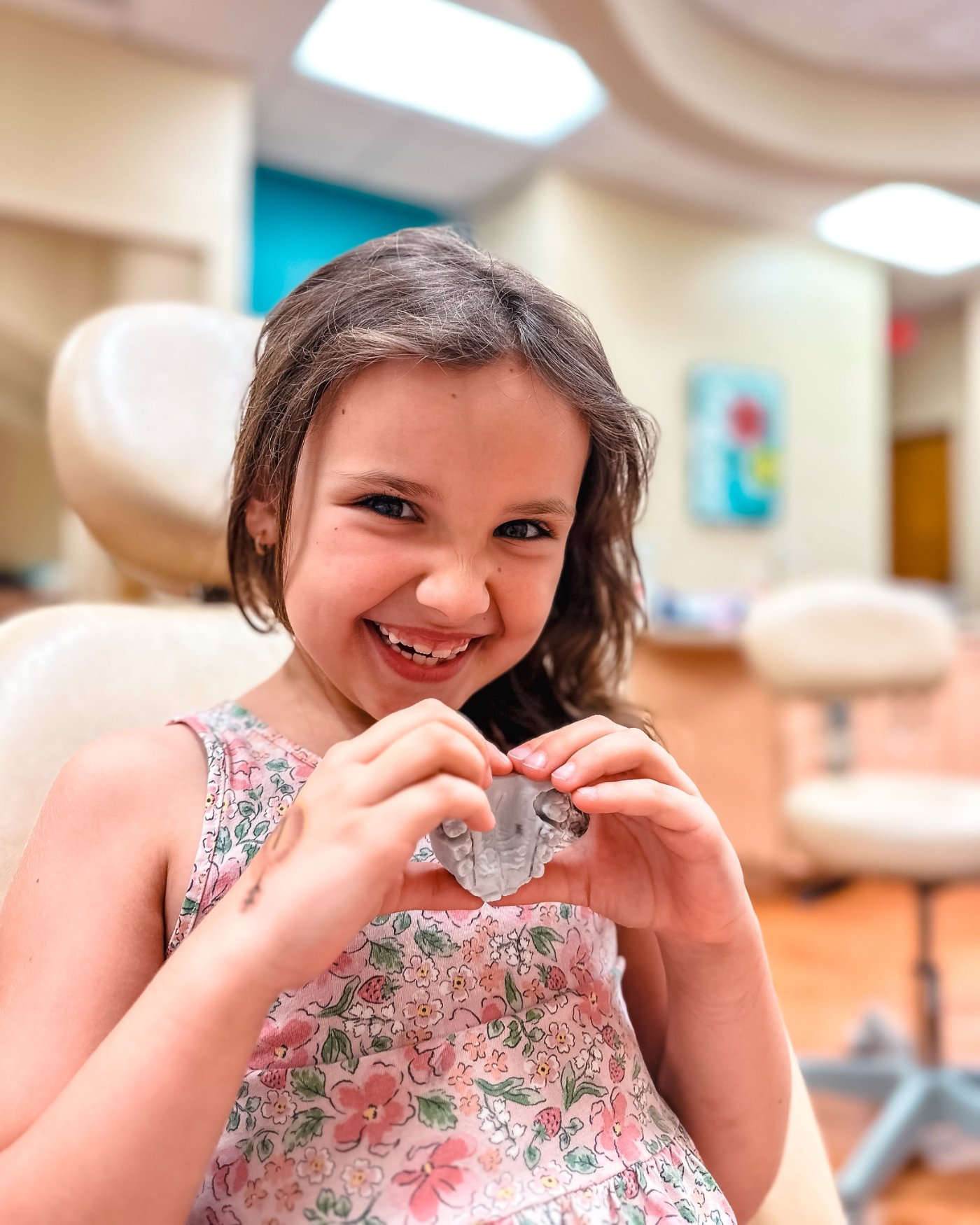
By age 7. The American Association of Orthodontists recommends that children be checked by an orthodontist by age 7, and no referral from your dentist is needed.
At that age an orthodontist can see how the jaw is growing and where the adult teeth are headed. The evaluation at Ogden Orthodontics is free, and so are the follow-up checks if your child only needs watching.
Dr. Ogden examines your child's teeth and bite, and we take a digital scan. He tells you in plain language what he sees and whether to treat now or wait.
If treatment makes sense, you get the plan and a written price for each phase that day, with no obligation to start. Most families leave knowing their child only needs another free check later.
Dr. Ogden offers free orthodontic evaluations for children from around age 7 at all three offices. Families in Minneola, Groveland and the rest of South Lake County are closest to the Clermont office.
He is the only orthodontist at all three Ogden Orthodontics offices, so the doctor who evaluates your child is the one who treats them through both phases. All three are open Monday through Friday, 8:00 am to 5:00 pm.
1381 Citrus Tower Blvd, Suite 102, Clermont, FL 34711.
Call (352) 242-0003.
Close to Minneola, Groveland, Montverde and Four Corners.
Visit the Clermont office page
1805 Maguire Rd, Suite 101, Windermere, FL 34786.
Call (407) 909-3003.
Close to Winter Garden, Horizon West, Dr. Phillips and Ocoee.
Visit the Windermere office page
2110 N Donnelly St, Suite 700, Mount Dora, FL 32757.
Call (352) 735-0004.
Close to Eustis, Tavares, Sorrento and Umatilla.
Visit the Mount Dora office page
Reviews
For most children, yes. Age 7 is the right time for a check, not usually for braces. Only children with a specific problem, like a crossbite, start treatment that young.
No. There is usually a resting period between them while the rest of the adult teeth come in. Some children wear a retainer during that time, and Dr. Ogden checks in periodically until the timing is right for phase 2.
Often, yes. Phase 1 handles one problem while the jaw is growing, and many children still need a second phase once the adult teeth are in. Dr. Ogden will tell you how likely that is before you start.
That depends on the problem. A narrow upper jaw is harder to widen after growth slows, while protruding front teeth can usually be corrected later with a higher risk of injury in the meantime. Ask what waiting would change for your child specifically.
Yes, and it is free. Bring the plan and any X-rays you were given, and Dr. Ogden will tell you whether he sees the same problem and whether it needs treatment now.
For clear-cut problems like a crossbite, most orthodontists agree. For borderline cases, such as mild crowding, reasonable doctors make different calls. If you have heard different answers, ask each office what specific problem their plan treats and what happens if you wait.
Usually not. Mild or moderate crowding at 7 often looks worse than it will be, and it is usually treated once, after more adult teeth are in. Early treatment for crowding makes sense when there is clearly not enough room for the adult teeth to come in.
Two phases means two fees, so treating once is usually less in total. Phase 1 is worth the extra cost only when it fixes something that would be harder, riskier or impossible to fix later. At Ogden Orthodontics each phase is priced separately, in writing, before you start.
Yes. Send a few phone photos through the free virtual consultation, and the closest office will follow up with what Dr. Ogden sees and whether an in-person visit makes sense.
Free evaluation
One free visit gets you a plain answer about your child's bite, and a written price for each phase if treatment makes sense. If the right call is to wait, you will hear that too.
